Description
In my role as a Learning Designer at Cambridge University Press and Assessment, effective communication and collaboration are at the core of my responsibilities. I routinely engage in various communication processes, both within and outside our team, to ensure the successful development of educational content. Here, I will describe my involvement in the communication and collaboration process, highlighting key aspects and experiences that have shaped my approach.
Early design communications
One of the primary ways I engage in communication is through kick-off calls and curriculum workshops with academics. These initial interactions are vital for establishing rapport and building a foundation for collaboration. During these calls, I aim to understand the course aims, provide an overview of our expectations as a team, but most importantly foster a sense of trust and mutual understanding.
This involves active listening, asking clarifying questions, and aligning the academic’s goals with our project objectives. For example, during a curriculum workshop, I spend some time with an academic discussing their ideas for the course. After listening to their thoughts, I ask questions, coaching the academics to rethink their ideas in ways which benefit all learners and meet the time constraints. These calls serve as the first step in creating a strong working relationship and they help the academics benefit from the learning designer’s experience and expertise.
An recent example of that is from my latest Curriculum workshop for a course in Natural Language Processing. This is a call that happens at the inception of a course idea, where we discuss how it can be structured and assessed. There were multiple elements that we changed on that call, but for the purposes of this portfolio I will only list one. The academic wanted to ask learners to speak to their colleagues as part of every assignment, which was unrealistic as some will be coming straight out of university and will not be in employment. Recognising this, I asked questions that got the academic to realise the limitation and adjust the proposed experience to something that all learners could do. In doing this, I was able to help him learn from my practice and adjust the product offering in a way that benefits learning.
Design workshops
As projects progress, kick-off calls evolve into a series of workshops involving academics and a wider team of professionals, including graphic designers, project managers, editors, and videographers. These workshops serve as a platform for brainstorming, ideation, and knowledge sharing. They allow us to collectively shape the course content and ensure it aligns with the pedagogical goals.
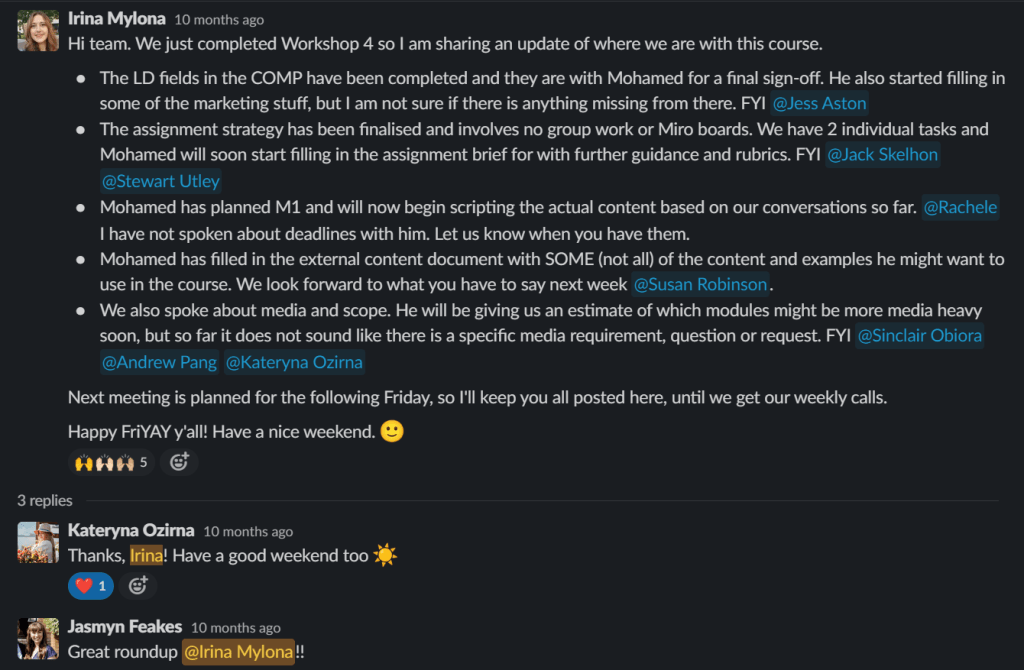
Through these workshops, I facilitate collaborative discussions, ensuring that all voices are heard, and ideas are considered. For example, graphic designers might join us to discuss the possibilities for images, or videographers might be present to discuss media scope. My role there is to mediate, manage expectations and help translate our processes into manageable tasks for the ACL to consider. This iterative process fosters creativity and innovation, resulting in more engaging and diverse learning materials. At the end of each workshop, I post round-ups which provide insight to the wider project team. An example of that can be seen in the image below.
Marketing copy
At the end of all the learning design workshops, my role is to summarise the main course concepts and disseminate them to the rest of the teams. This is particularly relevant for the marketing and enrollment teams.
Using my experience of working with the the course closely, I create copy that marketing use to promote the course and enrollment rely on for sales purposes. I write short course descriptions, module summaries and assessment outlines which get reused in marketing brochures and other collateral. Oftentimes, I also work with the marketing team to finesse their text for campaigns and social media posts. In being the person with the most knowledge on a particular course, I am often in conversation with the operations, marketing or enrollment teams, sharing my knowledge of the course content and design to help them overcome challenges.
Content reviews
Content design and development, which are both crucial aspects of my role, require continuous feedback and refinement. I achieve this through a series of ACL/LD review loops and weekly calls with the academic.
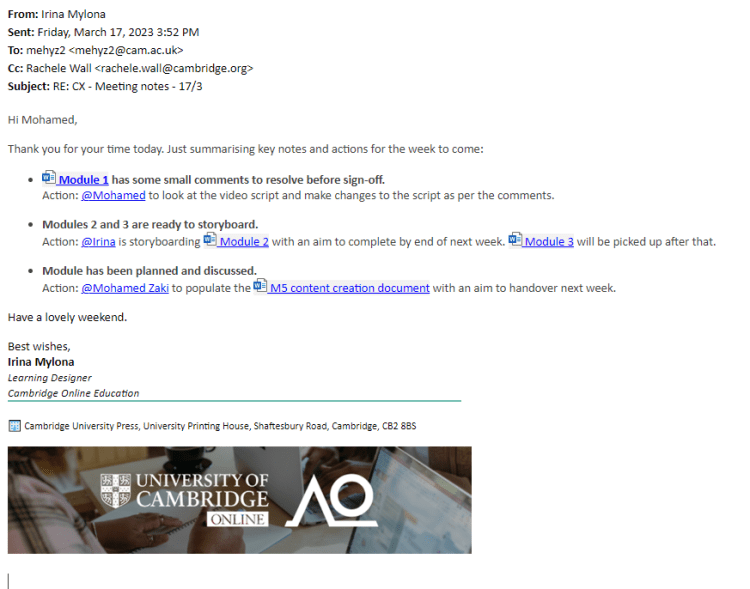
Each of these interactions has an agenda with clearly set out aims and questions to discuss. These ACL meetings serve as opportunities to assess progress, identify challenges, and make necessary adjustments. They also ensure that the final product aligns with the academic’s vision while adhering to instructional design principles. The image below is an example of the follow-up communications and action points that I share with academic.
Internal communications
Within the team, communication is managed through internal docs, Slack messages, weekly meetings and comments on Trello. We have a series of documentation that I maintain as a designer.
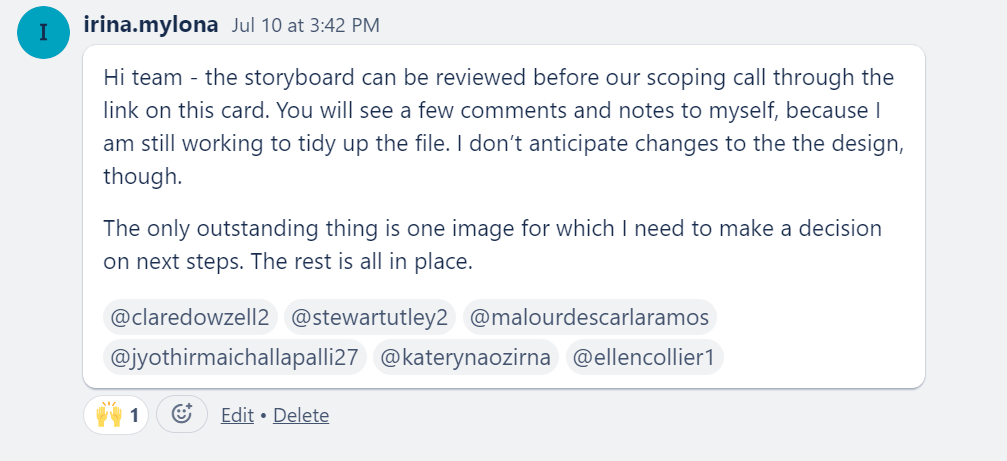
For example, there are Trello cards that I use to inform the team of next steps, scoping sheets where I estimate visual assets based on our allowance, project calls for team updates and scoping calls to discuss the work at hand. My role there is to clearly describe what each module involves and discuss any challenges with the team with an aim to creatively resolve them. The screenshot below is an example of this type of communication.
Reflection
Reflecting on my experiences in communication and collaboration, several key lessons have emerged, which have enhanced my ability to work effectively with others.
1. The importance of clarity in communication
Whether through media briefs or text messages, it is essential for me to convey messages concisely and comprehensibly. Ambiguity can lead to misunderstandings and delays, which can be detrimental to project timelines. Being a non-native English speaker, I am always mindful of my messaging and sometimes it is difficult for me to find the right words to craft compelling messages.
I try as much as I can to have a clear, well-structured communication and I think that tends to come across and facilitates smooth project progress. I aim to keep my messaging crisp, concise, and visible at all times. Looking back at the feedback I received, I think this has been well-received by my colleagues, who often praise my storyboards and communications as ‘very clear,’ ‘straightforward’ and ‘great to work with’. More recently the team has started expanding across different time zones, so I am now reflecting more on my intercultural communication and how I can be inclusive when working asynchronously.
2. The significance of timing
After a series of these kick-offs and workshops, I have realised that to maximise the impact of the work at hand, you need the SMEs to be able to engage. The worst thing that can happen is have an SME attend an online workshop, only to see them distracted by their physical environment.
In my first instructional design roles, before the pandemic, most SMEs were joining from their office environments, where they were focused on their work. However, with flexible working now in place, I have seen SMEs being distracted by life admin in their physical environment. So, when I book weekly calls or workshops, I make sure I allow my SMEs to choose a time that works best for them. This has multiple benefits as it:
- fosters better engagement
- leads to increased focus in the course planning process
- prevents disruptions and reduces misunderstandings
I believe that asking people to choose a time that works for them shows respect and lays the foundations for a strong working relationship.
3. Cognitive overload
At the start of a project, there is a lot of information to share, when onboarding the academics. To address this, we have spaced out workshops across a couple of weeks, allowing academics to settle into our ways of working. This is a business decision, but often learning designers are expected to share all the information planned for each workshop, as if it is a checklist to be completed.
I recognise that communication is not going through a checklist. So, I use the workshop aims as a guide, but I select what I will share based on how the conversation is going. I feel that this way academics are more receptive to the information I have to share, than if I announced it all via a list.
This approach minimises cognitive overload and enhances the effectiveness of our collaborative efforts. I do not want to simply convey information, I want this information to be meaningful and impactful. The feedback that I have been getting from my ACLs is that these conversations are extremely helpful, and the notes and links I send post-workshop are useful reminders that support them in completing their work faster and easier. I see this as an acknowledgement of the personalisation that goes into my communication.
4. Early flagging
Finally, I have learned the value of early problem identification and resolution. By proactively addressing issues and challenges with the team, we effectively manage time and future challenges. Although this is easier said than done, I have found that early flagging helps create a team problem-solving spirit that ensures that potential roadblocks are swiftly addressed.
The challenge I am facing with early flagging sometimes is that people are not ready to see the flag. So there have been cases when I raised a problem early on, but nothing happened until the very last minute. While this can be frustrating for me, I recognise that not all people are ready to deal with what I see as a problem, when I see it. Building these courses is a team effort and there are often team roadblocks that I do not see. However, from my perspective I now work to improve my influencing skills, so that I can help raise the status of the challenges I encounter.
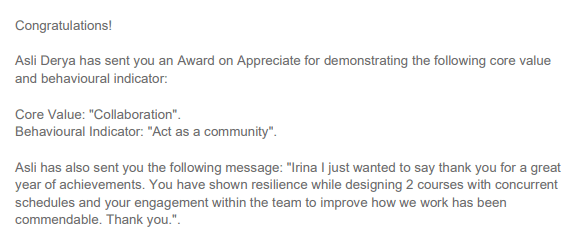
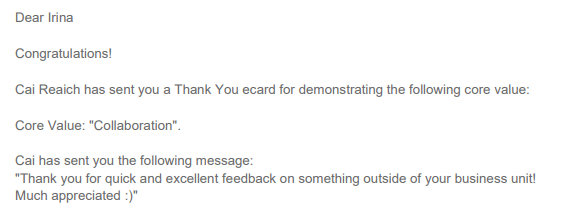
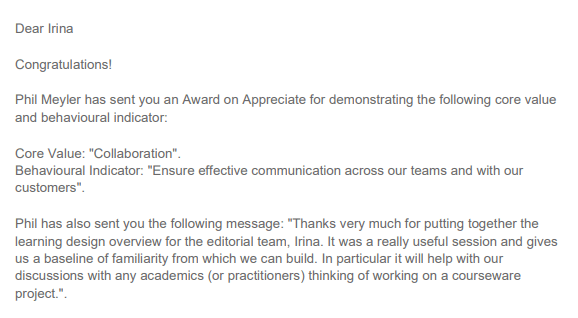
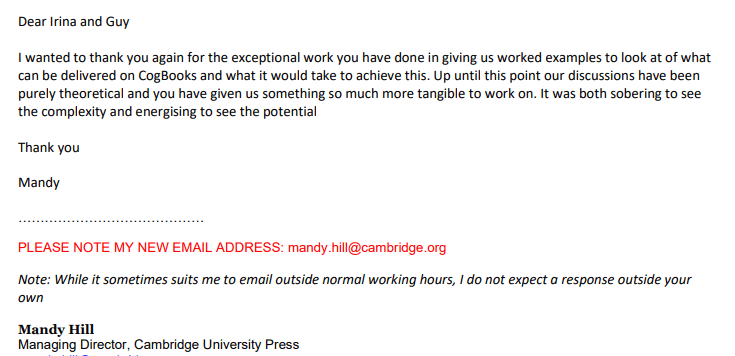
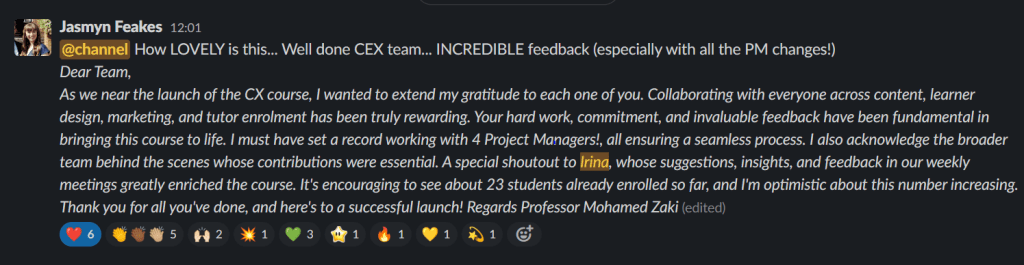
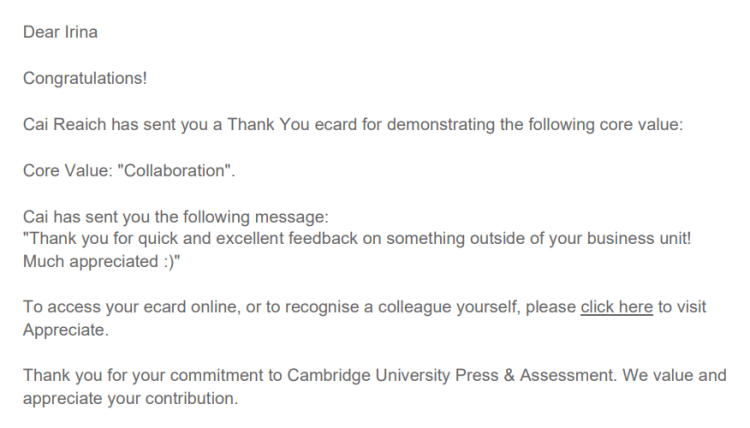
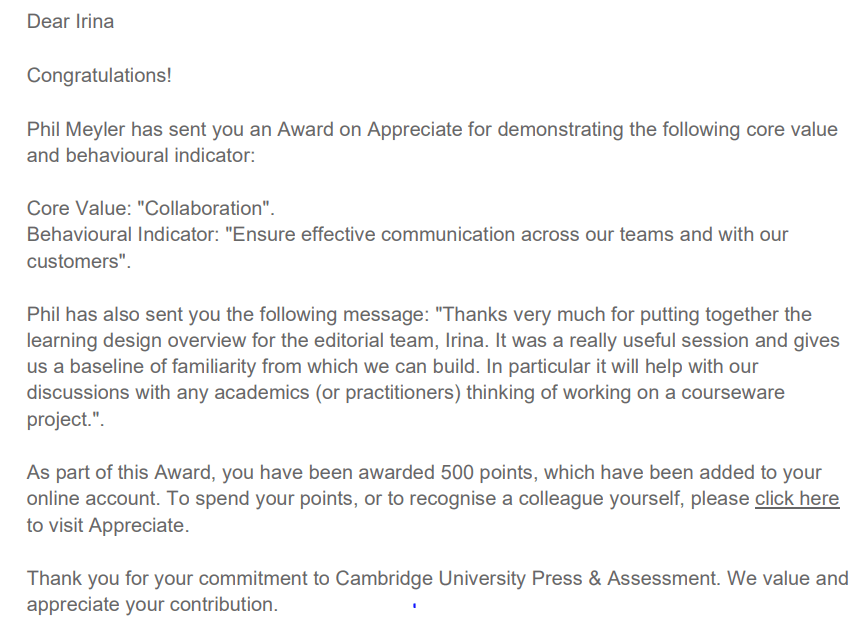
While all of these claims above are hard to prove with tangible evidence, I believe that you will agree with me that the following messages are speaking for themselves. They are comments, thank-you cards and recognition received from the academics I work with and other colleagues from the business which show how my communication skills relate to the business and team culture.



Reflection summary
I am someone who works constantly to improve my communication skills. When working with academics and colleagues, I try to remain mindful of clarity, timing, cognitive load management, and the need for agenda-setting. From the start of my career to now, I believe that my ability to work effectively with others has improved thanks to clear communication. Going forward, I would like to refine my active listening, coaching and emotional intelligence skills.
Disseminating practice
In all the interactions that I listed above, I also work hard to disseminate my practice. For example, I often advise my academics on what (not) to do based on my experience. I also often debate with my team why certain technologies will (not) work for the purposes of our context. A recent example is a conversation we had about using the H5P branching scenario tool for bespoke interactive scenarios. We needed to be able to track learner choices in the experience and I could see how my team’s proposed solution did not meet the requirements of our learning. So, I created mind maps of what the learner experience should be like and spoke to my team about how this will support learning. This approach enabled my team to share my learning vision and work towards finding a tool that would address the needs of our project.
In addition to that there are many other groups that I am part of, working to learn from them and also disseminate my practice. To find out more about them, click the blocks below.
1. The Advancing Educational Practice community
I speak with this group as part of an academic programme I am part of. We often do close readings of literature, talk learning theory and pedagogy with reference to my role. My group has found my expertise on digital learning inspiring, as a lot of them are rarely using technology in their face-to-face teaching. They often come to me with questions or ideas and my experience never fails to spark a good group or individual discussion.
2. The instructional design meetups
These are organised by colleagues at the Judge Business School here in Cambridge and London. I have enjoyed attending them, because meeting with local learning designers and ed-tech enthusiasts from the area is always the highlight of a working day. The meetups are informal, but we use them to get to know each other and exchange ideas about our practice.
3. Internal show and tell sessions
My team has these social drop-ins to share practice and ideate and I have led a series of those. I have also done this in previous workplaces, as standard practice. Some of the topics that I have presented in include showcasing tools, or previous work. I have also created more robust slideshows discussing neuroscience applications to learning design and more recently how ChatGPT can help us in design.
4. Volunteer work
There is nothing I love more than using my skills to better the community and over the years I have taken part in volunteer work such as creating courses for LearnAppeal and Keelworks, or helping Ignite Hubs set their online learning space to teach children how to code. I have also supported a few instructional design newbies and coached them through the world of e-learning. An example of that is my work with Dana Kocalis to create an online course that helped junior designers gain experience.
5. Setting up new communities abroad
Admittedly, I also tried to set up a digital learning network for my own home country, Greece, on LinkedIn. Despite some informal catch-ups and more formal posts, I was unable to set up the community of practice that I wanted to. In time, I want to return to this and throw more effort into shaping my Greek community. I would also love to start a podcast there, although currently there is no time for this.
6. Helping charities help others
In addition to my work with the volunteer groups above, I wanted to list my experience with Mosaic Initiative separately. Back in 2020 I worked with them to develop their online ‘Teaching Unplugged’ syllabus, as part of my role at Omniplex. I helped trained their instructional designer in the use of Articulate Rise. This enabled her to create lots of teacher training for their English Language Teachers abroad, who helped thousands of migrants enter University.
7. Conferences, networks and talks
Over the years, I have taken part in more webinars than I can remember. I have also been a member of the E-learning network, interacting with a few of their members through events and their mentor scheme. In addition to that, I have been visiting exhibitions like the Learning Technologies in London, or online events like the Digitally Enhanced Education webinars from the University of Kent. I am also on the lookout every year for the talks in the The Digital Universities UK, where I can learn from the practice of others and ask questions.
As I mentioned previously, I am proud to be a ‘Digital Accessibility Champions’ in my organisation, taking part in conversations, meetings and webinars with my colleagues to discuss how accessibility can be met in our work to the highest standard.
Going forward this year, I will certainly be attending a local conference, called the ‘Cambridge Teaching Forum 2024‘, where I am considering showcasing my work alongside my colleagues.
8. Supporting the wider organisation
I have been blessed to work with multiple divisions of my organisation and people have heard about my team and our expertise. Learning design is a new skillset in CUPA, and there’s increasing demand for it. In multiple cases, people have come to me with questions and I have either provided feedback on their work, or run presentation on what learning design is and how it can help them.
The cards below have show thank you cards awarded to me, for sharing my expertise with teams outside my own.
Where would you like to go next?



Core area 4: Communication with others
(You are here.)
 - IMID -