This section is made up of tow parts, which you can quickly access from the links below.
- 2a: An understanding of teaching, learning and/or assessment processes
- 2b: An understanding of your target learners
2a: An understanding of teaching, learning and/or assessment processes
Description
My experience in the field of education consists of a dynamic fusion of teaching, learning design, and continuous professional development. I have a background in English literature, teaching, and linguistics and a qualified teacher status. Building on that, I trained as an Instructional Designer through my master’s in Digital Technologies, Communication and Education (TESOL) from the University of Manchester. Taking classes in the School of Education, I was equipped with a deeper understanding of instructional design strategies, multimedia principles, media literacy and educational technology. Through all these experiences I developed a solid foundation of theories of learning and teaching, made my first attempts in instructional design, and delivered teaching as part of my module requirements.
In the years that followed, I put all this knowledge into practice while working as an English teacher and Special Educational Needs (SEN) teaching assistant. Later on, when I became an instructional designer, I applied the same skills and experience into digital education. Up to this day, I continuously work to retain and enhance this knowledge, by completing further training. For example, this year I took further training from Cambridge Assessment in how to craft better quiz items and stronger assessment rubrics. I also undertook training in curriculum design, aiming to understand how this aligns with learning design and learn from that practice. My next step is to gain a Fellowship with the Higher Education Academy through the Advancing Educational Practice Programme from the University of Cambridge. This started in September 2023 and it is scheduled to commence in July 2024, enabling me to reflect on my teaching philosophy, advance my practice and network with like-minded individuals from the University of Cambridge.
So, as you have realised by now, my teaching journey has spanned across various contexts, from English Language teaching to specialised digital courses. While the subject matter differed, all courses that I developed were deeply rooted in learning theory and I have always worked to put learners at the heart of my design. I will share two concrete examples here, to show how I relied on learning theory and context to craft the assessment strategies for two different digital courses.
1. A module for the MA Education – University of Hull Online
Time commitment: 12 weeks, 25hrs per week
For the ‘Education Explorer’ module, it was important students were exposed to different academic works and assessment practices. For this reason, we employed a “patchwork assessment” strategy. What this meant was that learners completed different digital tasks each week, which allowed them to display their understanding through a diverse range of artifacts such as essays, presentations, and even infographics. The students could then select a series of those pieces to reflect on at the end of the course. They were expected to create an academic paper that listed these examples and tied them with research and reflection to tell a story of self-development through the module. Screenshots of this course can be found in the link below. The patchwork assessment strategy can be seen in the ‘Assignment’ tab and in the challenge activity for Module 1.
2. Compelling Communication Skills – Cambridge Advance Online
Time commitment: 6 weeks, 6hrs per week
This course had a time-restricted nature. So, there was not as much space for academic research. So, to equip learners with tangible skills, we employed a more practical assessment strategy. Students engaged in tasks that simulated real-world communication scenarios, such as writing cover letters, stories, and recorded pitches. Assignments were problem-based, and the work was shared with tutors. I also worked to create feedback opportunities, so that learners review each other’s work with an aim to make it better. If you would like to see the briefs and marking rubrics of this strategy, you can refer to the file below.
Reflection
I have started as a novice in the field of education, training as a teacher and learning how to give feedback constructively. Over the years, I have been learning how to teach through technology and I have been reflecting on my practice in action and on action. While this is not an easy task, I believe that I have been incrementally refining my practice, shaped by novel ideas and feedback from people I interact with. It has been challenging at times to question my own beliefs, as shaped by my context and acknowledge new realities or biases. However this is where the interaction with communities like the AEPP course are vital. As part of this I have engaged in discussions about my practice, peers observed me and gave me feedback and I also did the same for them. This has been an insightful exercise, helping me challenge some of my thinking, inspire others, and get inspired by their work too.
My professional and personal learning experiences have been dynamically shaping my design approach and will continue to do so, as time goes by. I have learned many realisations along the way, and here I summarise my key reflections.
1. Learner contexts and learner characteristics
Whether in a classroom or a digital space, each group of learners comes with unique backgrounds, prior knowledge, and learning styles. When working in schools, I was adapting teaching methods and assessments to suit individual needs, e.g., using ability groups to teach the same concept.
However, when I moved to the digital sector this quickly became a challenge for me, especially when the target audience needs were unclear. Coming from a school environment, I initially pictured my learners as a culturally homogeneous group. However, this was not the case. Upon reflection, I realised that in the digital space it is not always easy to know the learners as you do in a classroom, but you still have to respect their context and meet the learning needs.
So how can we get a sense of who they are? Currently, the way I do this is through market research and discussions with the stakeholders. While it is hard to get a sense of exactly who the learners will be, I work with three personas: average learner, novice and expert. I include a variety of activities, optional resources and tasks that scaffolds the novices and challenges the experts. This has been working well, especially in my most recent courses where there are ‘optional tasks’ for those who want to go the extra mile and ‘extra reading’ for those who need to more context. This approach is currently being looked at systematically by the wider team, to evaluate the effectiveness of optional tasks with data. While these decisions for change are not only driven by me, I keep an eye on the activity and monitor the feedback to understand who the actual learners are and what content refinements we might need to make. Tailoring courses for global, intercultural audiences is my latest teaching challenge, which I am working to overcome.
2. Time-bound assessment strategies
In the example I shared above about patchwork assessment, the course duration allowed learners to have time for crafting the artifacts, reflecting on them, and collating them to tell a story. In a course like Communication Skills, when learners only have a few hours to spare among their workload, a more complex assessment strategy was not an option to consider.
In the past, and to be honest in some recent courses too, I have not been as thorough with learner time commitment. So, a key consideration for me is to respect the learners’ time.
If people are joining an online course, committing only a certain amount of time, we have to respect that and design the task and assignment in a way that aligns with this. I often work backwards from the time I have allocated for the overall experience, making sure that the student time is both respected and protected. However, when timelines are pressed, often these things slip through the cracks.
This became even more obvious to me recently when we got the feedback for my ‘ESG Risk Management’ course. For that learning, I went against my instincts and allowed the creation of a more elaborate assessment strategy, as a test for the first course run. The result was learner and tutor fatigue and complaints about assignments taking a lot of time to complete and mark. So, taking the feedback in, I worked with the ACLs to simplify the assignments after the course concluded, and we are monitoring how the change will go for the second round. Knowing how long people will take to complete tasks is a challenge for me, especially when I lack familiarity with the subject matter. I rely on the academics and feedback to get a sense of this and when I see learner challenges, I work with my team to refine them.
3. Authenticity in assessments
The success of the Communication Skills course was immense, and I feel that part of it was down to its authentic assessments. This course helped me see the value of authentic tasks in assessment; when assessments mirror real-world scenarios like authoring a story or a cover letter, learners perceive their educational journey as relevant and valuable. By integrating authentic assessments, I have witnessed heightened engagement, as students recognise the practical application of their skills beyond the classroom.
This was the first time I encountered this, as previously I either worked with academic work, or with simpler knowledge checks. I have since been following this route for other CAO products like our ESG Risk Management and Data-driven Customer Experience courses and I plan to keep refining and perfecting this approach based on learner feedback.
4. The importance of assessment transparency
Furthermore, through my experiences in digital learning, I came to recognise the importance for assessment transparency. The first time I encountered ‘marking rubrics’ loaded onto Canvas was in 2021, while developing online Master’s. Some of the learners fed back that more transparency would be helpful in assignments, and I realised that adding it to the platform would make the requirements and marking scheme straightforward.
This experience helped me see that when students have a clear understanding of how they will be assessed, they can better prepare and channel their efforts effectively. Since then, I have been adding rubrics to assignment pages and more recently at my current role, I have been creating Assignment Brief documents and grading criteria to share with learners.
Reflection summary
My relationship with teaching, learning, and assessment has been shaped by formal training and experiences with varied contexts, assessment transparency, and authenticity. By aligning learning theory with instructional design strategies and continuously reflecting on my practice I have evolved as an educator and I am confident that I will continue redefining teaching, learning and assessment as I grow professionally.
2b: An understanding of your target learners
Description
In my career so far, I have been blessed to work in a variety of contexts, catering for learners with different settings and needs. For this section, I will use an example from when I was an Instructional Designer at Omniplex, creating bespoke e-learning courses, for specific clients and contexts.
Back then, I had to understand the needs of each context, and then channel my insights into creative learning solutions. One example of this is when we worked with Thames Water to design bespoke e-learning courses that catered for various parts of their workforce. More specifically, I lead the development of two course suites: a management induction and a general staff induction. Each was composed by a series of courses which were to be completed as a bundle.
Working closely with Subject Matter Experts (SMEs) and Thames Water’s teams, we delved into the contexts of each target audience. I asked questions about the company culture, audience demographics, preferences, and digital skills. For example, ‘Who are the learners?’ ‘What do they need to do after completing this course?,’ ‘What is the aim of the course?’, ‘What happens if they don’t take this course?’ etc. The answers to these questions gave me insights that I used to design each suite. The following sections discuss the individual work in more detail.
Management training
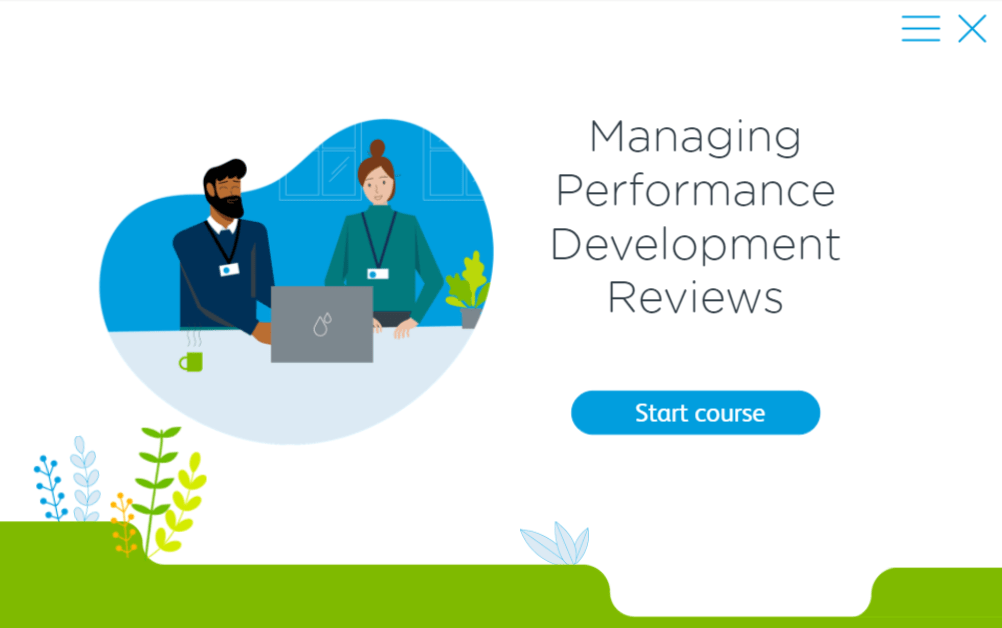
For the management training suite, we were mostly working with an older audience, much more corporate and with limited time. Managers needed practical skills, useful forms, and resources. They needed to know what to do when challenged and where to go to find support. So, with that in mind, I designed a structured experience, using a corporate theme, and followed Gagne’s 9 events of instruction.
Each e-learning module was short (20 mins), gaining attention with a splash screen and informing of the objectives. Then we worked to activate prior knowledge through scenario-based activities, present more information and opportunities to practice, before finishing with a knowledge check and links to useful internal sites. The use of scenarios was core in this because I aimed for learners to draw on examples that might be familiar and develop practical skills while doing that. We also used videos from other managers in Thames with an aim to learn from other peers.
General staff onboarding
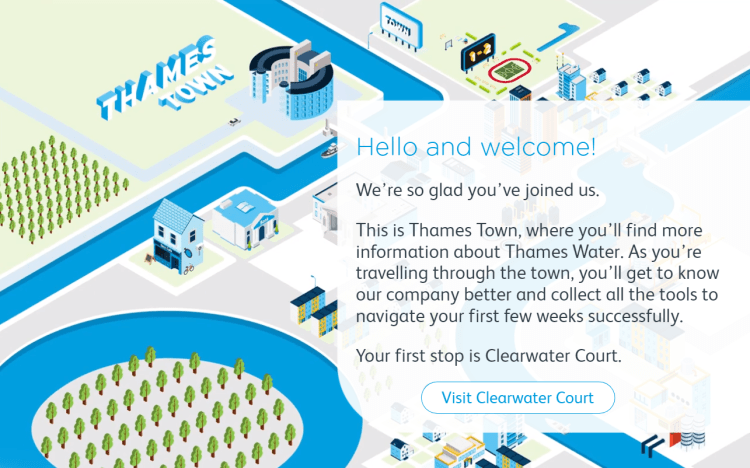
For general staff onboarding, I took a different approach. From my needs analysis I had found out that most of the new employees were from a younger generation. The main learning aim was to get them excited about their new employer. So, I opted for a storytelling approach and innovated the Thames e-learning by immersing learners in a virtual space. From my early learning days, to my teaching days I could see how stories are meant to stick and stir emotions, so I knew that this was the way to go for this suite.
We introduced Thames Town, a virtual town, which was composed of a series of buildings like Depos, water treatment plants and a Town Hall. Each location was the setting for a course, so for example, new employees could ‘Meet the CEO’ in the Town Hall, then learn about health and safety by visiting a Depot or learn more about Thames Water though a cruise in ‘The river of time.’ This town formed the basis of the induction, revealing the company culture and values in a captivating way. It was the best way to cater for a young audience who had just joined Thames and it was very well-received by the key stakeholders.
Revealing accessibility needs
Through the initial stages of design of Thames Town and the corporate suite, we asked Thames to run a User Acceptance Testing (UAT) to solicit some feedback for the build. This was really important to me at the time, as I had just finished working for a software company, which helped me see the importance of UAT. Even though I had no direct contact with the learners, I wanted to find out how the early build was received by a the target group. This turned out to be a crucial point for helping the client recognise their huge accessibility need. This was a bespoke piece of work for which work was quoted per module and level of complexity. It was a substantial financial investment for the client. Due to cost concerns, they did not want to pay for external voice recordings and other elements which would make the course more accessible, despite the strong recommendation to do so. Being in an agency environment, I did not agree with this decision, but I had limited authority over it.
For Quality Assurance purposes, we asked for UAT feedback between the alpha and beta versions of the course. A few of their staff used screen readers to access the material and the format of the alpha build was not suitable for them. This helped the client recognise the need and so they made a further investment in audio and redesign to address it. So, to my delight, we changed parts of the course design in the beta version, mainly in the interactivities. We went back and made sure that all elements were labelled to work with Thames Water’s specific screen reader, we added built in human voice audio and we removed any activities that would require drag and drops or sliders. In some cases, when this was not an option, we took extra steps to create alternative tasks, accessible only by those who use screen readers. To achieve all that, I worked with representatives from the learner community at Thames Water to understand which screen reader employees use and how to best cater for that. The final build was well-received at Thames, making our work a huge accessible success.
Reflection
This experience of creating tailored courses for Thames Water provided significant insights about different audiences and accessibility.
1. Two suites for a customer by one team
This was not the first time that I was creating learning for a specific audience. However, it was the first time when I created two distinct suites for the same client. Experiencing this helped me think creatively about how to use the same branding and context for a different learning purpose. The corporate suite was more serious, direct and practical. The general staff onboarding was playful and fun. I was surprised by my ability to tailor the language, tone, and structure to cater for these two experiences.
This success was in no way only driven by me. After the original ideas were conceptualised, I welcomed ideas from our content developers, graphic designers and even our management to make these suites a success. Our quality assurance team also helped refine the language and make it C-Suite appropriate. My colleagues at the time were enthusiastic about the opportunity we had, and we created a series of digital styles, concepts and visuals to choose from.
Thinking back at this now, this agility and openness to experiment is what made these suites so powerful. We were in close contact with Thames Water, working and iterating with an open mind and using the client feedback to refine our products. This approach is not something I have encountered in my post-Omniplex life and I think it is limiting the creativity in visual representation of my latest courses. If I could make a change, that would be to have more time with the SMEs and graphic designers to conceptualise the visual elements of our courses. Having a safe space to fail fast has helped me become more creative in the past, and I would love the opportunity to do that in my current role too.
2. Accessibility first
The most profound lesson learned from this journey was centred around accessibility. Collaborating with Thames Water employees who used screen readers allowed me to delve into their experience, uncovering the challenges they face, and the adaptations required to make content accessible for their own LMS and screen reader. This experience heightened my awareness of accessibility needs and gave me an understanding of the limitations screen readers face, for example in dragging or sliding.
A learner-centric design approach, which prioritises accessibility, not only caters to disabled learners but also enhances the learning journey for all. This is something which has shaped my practice and since then I have been designing with an ‘accessibility first’ approach in mind, adding accessible interactions, transcripts, captions, and ALT text to my work.
Of course, this is something that is much easier when you work in a non-commercial setting, where all design decisions are made by the LD and not the client’s budget. Going forward, I would like to go beyond the WCAG guidelines and redefine our approach to accommodate for neuro-divergent learners as well. I think that accessibility is a big topic, which goes beyond screen readers and transcripts and I would like to develop a framework of my own to re-define it for executive education. This is something I would like to explore, potentially at a PhD level, if the opportunity arises.
3. The importance of User Acceptance Testing
Before Omniplex, most of the learner feedback I received came through either through the sales teams, or through the final course surveys. The collaborative user acceptance testing (UAT) with real learners gave me an opportunity to refine my design and cater for the target audience, in a way that I could never have done before.
This experience helped me realise the power of involving the target audience in the design process. This is something that I would love to keep doing in my current role, but unfortunately due to the limitations of our context, it might take a while until UAT is part of our workflow. For now, I access the learner stats and feedback at the end of each course run.
4. Sharing with the community
The work we did with Thames Water was shared and celebrated with our network. Initially it circulated within the company and later it was celebrated on LinkedIn. I also showcased this to share our best practice with freelance and temporaty colleagues that we onboarded at Omniplex. This happened through a series of induction calls, show and tell sessions, and when discussing how to creatively craft learning journeys.
The Thames Water Induction suite never failed to spark discussions around the importance of creative learning design, accessibility, and personalised learning at Omniplex. It is a piece of work that makes me very proud and I have been discussing this with my network, using this work as an opportunity to receive constructive feedback to shape my work for the better.
Reflection summary
Knowing the audience you design for is key. Sometimes in my roles I had access to this information, but others knowing the exact demographics is challenging. Therefore, my reflection as a designer is to offer support for those who need it, extra work for those who want the challenge and design with an ‘accessibility first’ in mind.
Where would you like to go next?



Core area 2: Teaching, learning and assessment
(You are here.)