This section is made up of three parts, which you can quickly access from the links below.
- 3a: Understanding and engaging with legislation
- 3b: Understanding and engaging with policies and standards
3a: Understanding and engaging with legislation
Description
Intellectual property and copyright were two terms that entered my working life quite early on. From my studies, I learned to not use images which did not belong to me for my projects and how to avoid plagiarism or infringing on intellectual property. So, naturally I was always mindful of these challenges. During the initial stages of my career a lot of the work I was doing was either ‘non-profit’ or for ‘educational purposes’, so we did not delve too deeply reusing images or formally requesting permissions.
As the years went by, and my role changed into more corporate settings, I started recognising the importance of abiding by the copyright law and took particular care to incorporate this in my design process. There were times, when I would ask the question ‘Can we use this?’ to our copyright team or add credit lines for stock visuals. My current role is the culmination of this experience, as I work with content editors to avoid copyright infringements, request the right permissions, and tweak the content if necessary. The below highlights an experience which details the work done to avoid copyright challenges in a recent course I worked on.
Compelling Communications Skills
In January 2023, we launched a course on Compelling Communications. This course included a series of speeches from famous public speakers, including Martin Luther King, Abraham Lincoln, and Barrack Obama. When working with the Academic Course Lead, I ensured that I asked for the source of the content and instantly consulted with our internal editor to discuss what this content means in terms of copyright. For some items, we were able to clear permissions straight away, while for others, we had to wait a bit longer. In some cases, when permissions seemed impossible, we even had to change the content drastically to achieve the same result, without infringing copyright.
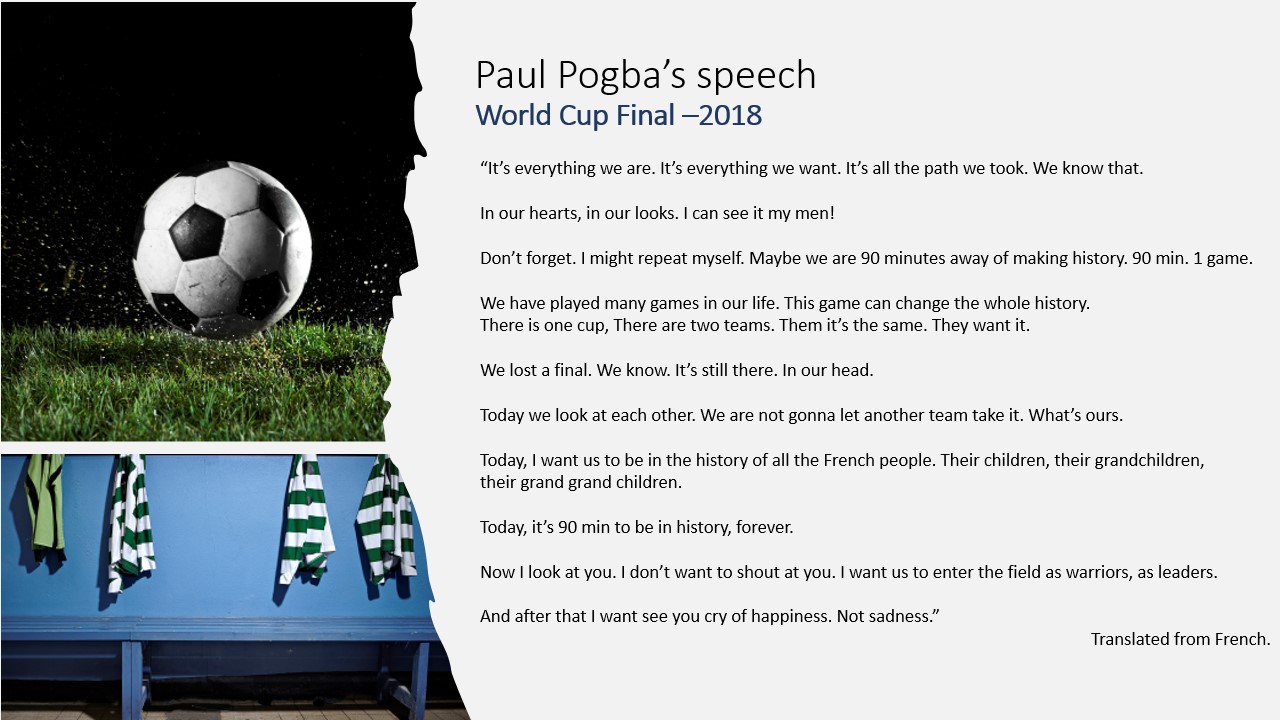
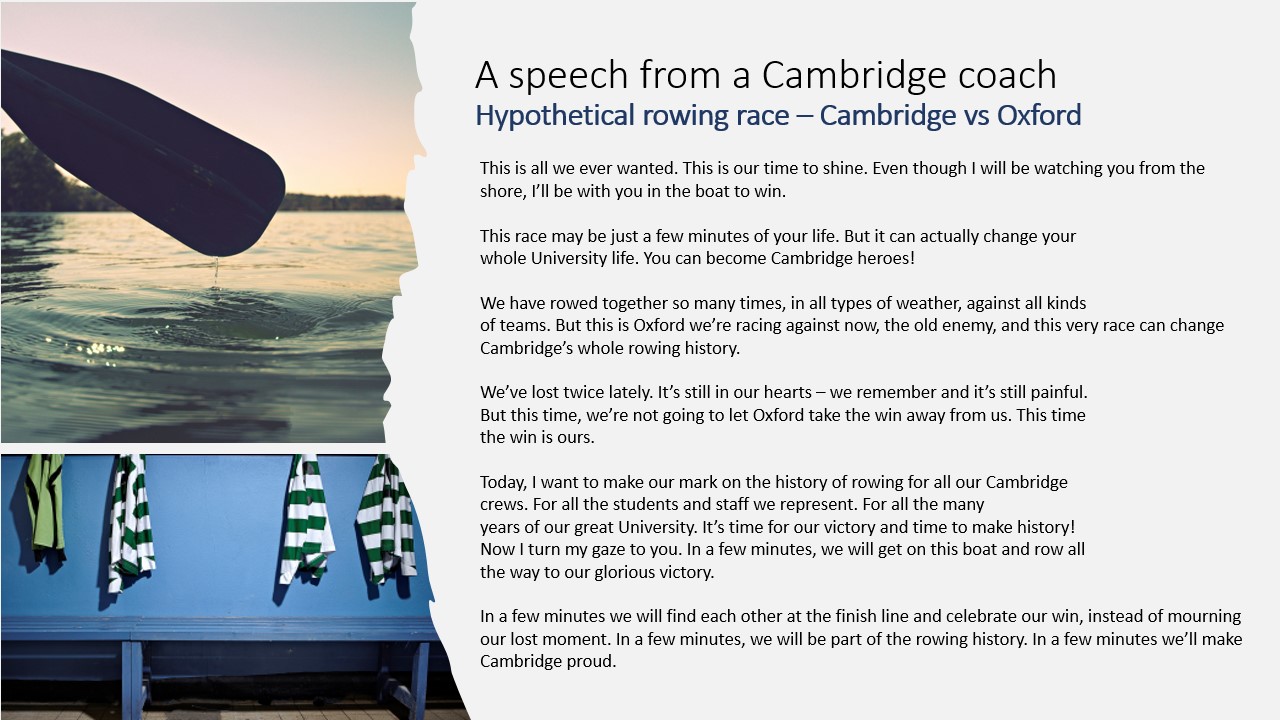
An example of that is a speech given in the football locker rooms of the French National team, before the World Cup Final. Paul Pogba, the captain at the time gave a speech to motivate his team. We translated this speech from French to English and identified a YouTube video of it. However, when looking closely it became apparent that the video did not have the right permissions and therefore, we needed to contact Paul Pogba to ask for his permission to reuse the content. Given the impossible nature of this task, and the tight launch deadline, I consulted with the team and then decided to rewrite this speech as a hypothetical scenario, inspired by Pogba’s words, but not infringing on the copyright of his speech. The result was a speech based on a hypothetical Cambridge-Oxford rowing race, which felt a lot more relevant to our Cambridge brand. We achieved the same aim, without violating copyright laws. An example can be seen in the interaction that follows. Please slide the line to compare the two images or download the PDF file which contains the text.
Reflection
There are countless examples like the above that I can list. From making changes to graphics, to re-imagining tables and data, or even creating bespoke interactive scenarios. The below sections list some of my reflections on the topic of copyright.
1. Copyright is a collective responsibility
It is not always easy to spot these permissions, the first thing I want to note here is that avoiding copyright should be a responsibility for all. There have been many times when my team has helped me see potential copyright blockers, and there have also been several times when I have done the same for them.
When we all have accountability and keep an eye out for potential violations, then we safeguard our brand and ensure we are not hurting anyone by infringing on their work. It is really important for me to act as a community on this and support each other with copyright law.
2. Copyright and creativity
There have been many times when I was faced with copyright blockers. The most common case is that I want to use an academic paper and its cost is prohibitive, or the permissions never come through. When this happens, naturally the first thing to feel is disappointment. However, these copyright challenges often come with opportunities to get creative. This is how I try to see them, to overcome the frustration I sometimes feel.
Since I realised that, I have been redefining these blockers as chances to do things a different way. For example, in our recent ESG Risk management course, there were multiple times when we simplified visuals or reworked content to avoid copyright infringements. These changes not only creatively solved our problems, but they also made the course more visual for learners, giving them something simple and effective to work with.
3. In-house expertise
It is not always easy for me to know how to avoid violating the copyright law, and I one thing I would like to change going forward is having access to someone who knows the relevant legislation to check things by. This is something that is available in my current team, but getting time with the legal department is not always easy to find or available when you need it. We have editors to check content by, but they are not legal experts.
So, I often invest time designing experiences after being told the content can be used, only to find out closer to course launch that in fact the content is protected by copyright. Therefore, I would love the opportunity to learn from someone who could advise me from the beginning on which digital content I can use and which I might infringe on copyright. As part of my personal development, I would also like to get a bit more in depth with these topics, especially the ones that relate with content generated by AI and the intricacies behind that.
Reflection summary
Copyright officially entered my life the moment I started working in more corporate settings. Since then I have been working hard to avoid reusing content unlawfully. While I still do not consider myself an expert, I rely a lot on my team and work to enhance my understanding constantly.
3b: Understanding and engaging with policies and standards
Description
As I mentioned in section 2b, accessibility became a topic I am enthusiastic about when I was working at Omniplex. Before Omniplex, I was aware of accessibility needs and standards, like WCAG. I had spent many years researching learning difficulties, and in particular dyslexia. Then during my master’s, I developed a website to empower students with dyslexia and ran research on it. After my Master’s, I worked in schools as a Special Needs Support Worker and all of these experiences equipped me with valuable insights about the challenges of learning.
During my first years in the digital learning industry, I tried to develop courses which were accessible, mostly thinking about readability, cognitive overload and working memory limitations. I was driven by intuition and theories on Mayer’s multimedia Design and Paivio’s dual coding theory . However, none of the businesses I worked in actively focused on accessibility needs, so the requirement was loose, and I had no formal training on how to design with accessibility in mind. The amazing experience I had designing for Thames Water fuelled a passion in me to continue building courses that are accessible for all.
So, since that day I have been working hard to develop courses that are accessible and learn more on this topic. I underwent some training on ‘How to deliver and sustain accessible digital learning – for HE and FE’ and how to watched some internal recordings on sessions for alternative text. This training gave me a holistic framework to follow when designing courses. In my current position we strive to meet a ‘AA’ standard and we are looking for ways to make courses even more accessible. Being the course designer, there are specific elements that I ensure to include, and these include:
- All images have a valid alt tag – I provide that text during storyboarding
- Captions and transcripts exist for audio or video – I create scripts which then get turned into transcripts
- The audio can be stopped, paused, or muted from the player
- No instructional text is hiding in hover states – this is an error of my past, which I now avoid
- Language is simple and concise – I work hard to create simple sentences and our editors help refine those
- There is a mix of media that ranges from text to images, audio, and video. – I create briefs, storyboards, and scripts for these assets.
- Elements on the Canvas page are well-structured and labelled, e.g., everything has headings and subheadings – I consider the page layout as part of my storyboarding process
- The courses are clearly structured and can easily be navigated using the keyboard – this is a follow-up from the above, which our content developers help with
- Activities have for clear aims and overviews – I ensure that instructional text is present before any task.
- Assessments have a detailed marking rubric and offer flexibility in file type submission – This is something I look at with the ACLs
- Self-tests offer detailed formative feedback – all quizzes have clear feedback and explanations on why answers are (in)correct.
- Social elements are included in the course with an aim to build an online community – this includes live sessions, forums, and group tasks which I create across each module
Reflection
While I am certain I have a lot more to learn about accessibility, the experiences I have had have helped me recognise the impact we are having for learners. Like in all previous sections, I am summarising my thoughts below.
1. Raising awareness and empowering learners
Special educational needs is a big part of my career, and it has shaped me as an educator. I used to work with students on the spectrum and learners with language delay, emotional disorders, and behavioural difficulties. I have worked hard to empower students with learning disabilities, through digital technologies, resources, and personalised support. I have seen my students thrive on spelling using tablets or grow confident in expressing themselves through digital games and presentations.
Since I moved into the digital learning space, I have been drawing on all of these experiences to create courses that are accessible. I do not believe this is something that can instantly be achieved, but it is something we can start by raising awareness and then move to resolving. For example, in my first role I ran research on accessible fonts, and collaborated with my team to select a font that would be easy to read by the majority of our learners. My interest in this topic helped raise awareness first and then urged the team to find a solution and take a step closer to accessibility.
Accessibility is for me a dynamic evolution of the work we do, to cater for learning needs. I do not believe there is a one-size-fits-all approach which can magically address all needs, but we can keep talking about it and taking steps towards a more accessible future. As part of that, I am a member of the accessibility champions in my organisation, attending talks, discussing all things accessibility and aiming to raise awareness about accessible course design.
2. Continuous development to make a difference
Reflecting on all of my experiences with accessibility, digital or not, I can see how we are making a difference in people’s learning and to an extent their personal and professional lives. This honours me, and it makes me proud to think that the work we do helps learners get one step closer to their professional goals.
Similarly, I do not claim to know everything about accessibility, but I work daily at bettering myself, and learning from my mistakes. For example, while I always had a focus on accessibility, my early work has many elements which I would now definitely avoid, because I know more, and I know better than then. My early designs included text that hid in hover states and drag and drop interactions, which I now know that a screen reader would not interact well with. While these are all things I now try to actively avoid, I am sure there are others which I still have to learn, hence I am keeping myself updated through network talks, seeing other work examples, and remaining open-minded for challenging my designs. When I feel that I need more guidance on matters, I also seek training, as for example courses from AbilityNet.
3. It takes a team to be accessible
One final realisation, which is similar to the one in copyright, is that accessibility takes a team to be reached. While working as an end-to-end designer, it was more difficult for me to label graphics correctly, design interactions accessibly, consider the language and alternative text of every single element in a course. The challenge came from lack of time and limited opportunity for ctitical reflection.
There were always some assumptions I was making, or my perspective was skewed due to heavy design and development involvement. Currently, with my CAO team, these accessibility sub-tasks are delegated to a series of teams, which makes management of the change so much easier to navigate and action. It also leads to increased accountability across the team, making it more likely that we meet the standards as a team.
Reflection summary
My knowledge of accessibility has been growing alongside my career and this is something which will keep evolving. I have been working hard to learn from my colleagues, share my knowledge with the team and work with them to empower our learners.
Where would you like to go next?
Core area 3: The wider context
(You are here.)
 - IMID -